When it comes to finding your sound, pedagogues tend to have different approaches. The most popular one involves becoming one with the sound. This touches on the common theme of "losing oneself to the music" or seeking and finding the "flow state."
While this is helpful, it isn't as practical an approach for those still finding their sound. Today, I wish to share a rather unusual technique I discovered that had some interesting results.
This solution, is astral travelling.
Well, not really in the true sense of the word, but an imaginative version, nonetheless. The logic is simple.
Say the following words aloud: "This is my voice and I speak with it."
Now, record yourself saying that same phrase with your phone.
When you listen back to it, you will notice a gap between what you think you sound like versus what you actually do.
This is also why many violinists find themselves cringing hard at how they sound in recordings. Despite the violin not being a part of our physical body, it makes physical contact with your skull via the left side of your jaw.
As such, your perception of how you play is quite similar to your flawed perception of your own voice.
The crude solution to this perception lag is to constantly record yourself and aim to iron out the differences. However, it is possible to reach a sort of real-time, biofeedback experience via the concept of astral travelling.
How To Figuratively Astral Travel
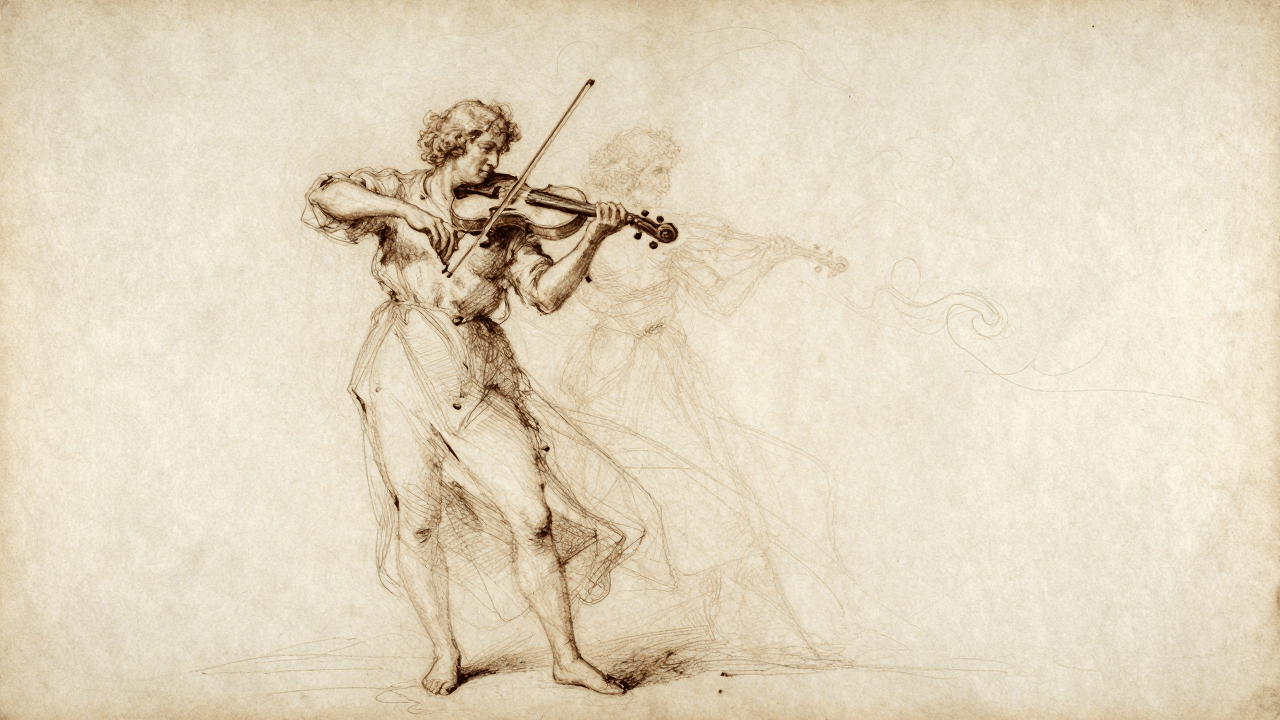
Your aim is to disassociate and create two versions of yourself that you experience simultaneously. The first version is your original self, the expresser, the violinist, the performer. The second version is the perceiver, the listener, the audience.
Visualize yourself seated in front of you, watching and listening to your performance. For some people, it can be tough to create this visualization. If you have difficulty with this, you opt for the easier version of an audio-only perception.
The most important requirement is that both versions of yourself need to exist in real time.
Start with playing the Open A string and switch places so that you are listening to it as your projected self.
Next, try a simple scale and then a simple piece. You will realize that your perception of your sound is far more accurate to reality now. The benefits to be unlocked are significant and include
- A completely new perception of your sound. You hear the warmth of your tone or its lack, the lack of confidence in tricky passages, the presence or absence of resonance, or minor rhythmic issues that you never noticed before.
- A new awareness of several maladaptive habits and choices and how they inhibit your ideal sound.
- A better understanding of how to convey emotions which can drastically improve your phrasing.
The only challenge to this method comes with tricky pieces where the mind has to concentrate on performing that the perceiver projection becomes tough. As someone who worked in mental health, this entire experience is best described as Musical Advanced Empathy. Except, you are the sole target of this empathy and not another person.
When done right, it feels like you have temporarily transformed into a four-dimensional being and can finally perceive and finetune your sound with pinpoint accuracy.