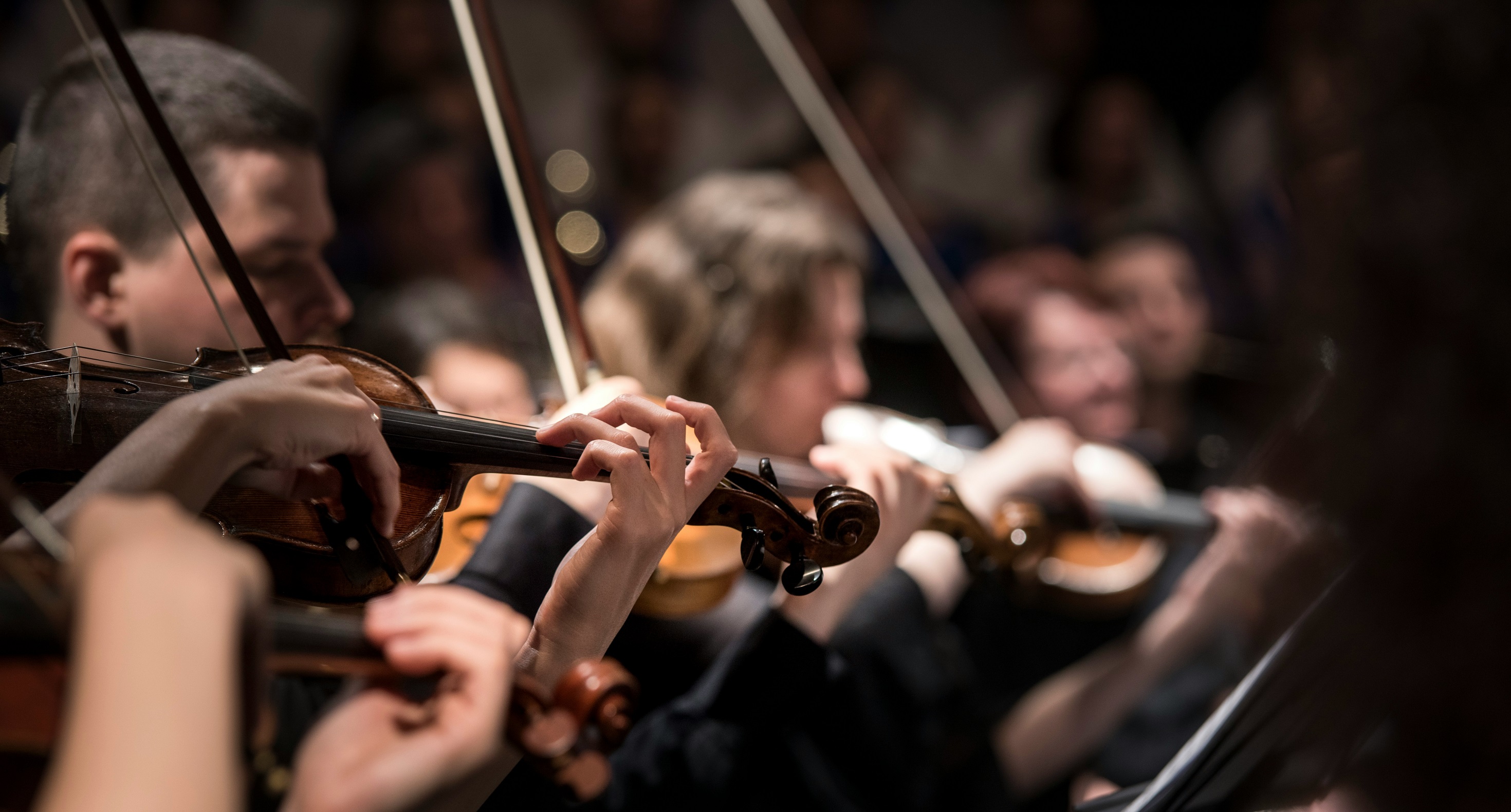
While a lot can be said about the importance of pedagogy, I believe there is no better teacher than music itself. Sadly, many students rarely go out of their way to listen to good violinists or violin-focused pieces.
They practice their exercises and assigned pieces but seemingly have no interest in the violin outside of lessons. They do progress and improve, but when compared to those who actively listen to violinists often, the difference is clearly visible.
It's why I encourage people I teach to actively watch and take in as many videos of pro violinists as possible. There are some aspects of violin playing that are otherwise difficult to develop without musical exposure. Here are three of them.
Musical Energy
Students who practice based only on their tutor's guidance seem to develop fine technically. However, there is a certain lethargy or passiveness that can be heard. They aren't making any obvious mistakes and even their use of energetic dynamics like accented notes are performed well.
Yet, there is a certain energy and aggression, and, on the other end of the spectrum, a pathos that is missing. Their playing feels like there is nothing to win or lose. The fingers press; thus, notes emerge. The bow moves, thus sound is created.
Essentially, without musical exposure, you play on an empty battery.
Musical Soul
On the surface, it seems somewhat counterintuitive. How would listening to others play give you a musical soul? As esoteric as it sounds, I believe that without exposure to good music and players, your inner musical soul becomes dormant and inactive. But what do I mean by this soul? In the simplest sense, it is the driving force behind the performance of a piece.
When you listen to good violinists, you might hear a phrasing, a way of playing, or a certain combination of notes that awakens a desire to replicate it. Many look down on replication in music, but it soon stimulates your own ideas and a genuine need to express something through your violin.
This is the awakening of the musical soul. After all, a bird may fly and preen colourful feathers, but what is a bird without its unique songs?
Musical Mistakes
Universally, the learning process is always about perfection. We are supposed to move from the rough to the smooth and no tutor deliberately teaches a student how to make mistakes. Our goal is to minimize them at all costs. Yet, mistakes have a part to play in the maturation of any musician.
Fritz Kreisler is my all-time favorite violinist and is considered one of the old-guard legends. However, compared to modern violinists, his technical skill isn't anything spectacular. In fact, there are possibly some high school-aged violinists today, who can play at a similar or more advanced level.
If you listen to some of Kreisler's recordings, you will hear mistakes.
The same goes for Yehudi Menuhin, particularly in his later years.
Yet, the music is not affected. Take a look at a recent discussion on the Violinist.com forum.
One user points out mistakes he noticed in Itzhak Perlman's performances.
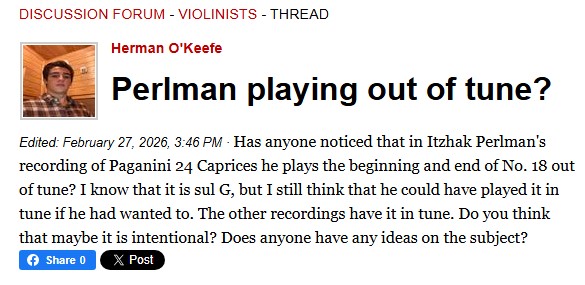
It is important that we understand that these
players never allow mistakes to take away from the golden tone that is produced. This is clearly visible by
some responses the question received.

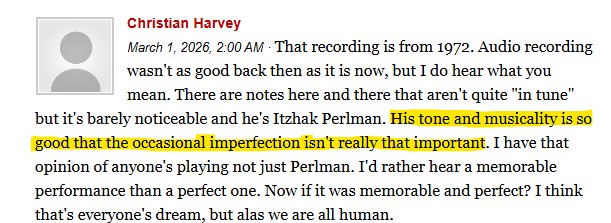
Harvey's point on memorable performances being better than perfect ones is something I will second.
It's like parkour. Imagine if bumping your arm during a jump caused you to stop abruptly and restart your run.
"It didn't go perfectly" you say. Yet, true parkour is flowing through obstacles,
with the focus being on the flow. Not on perfection. Integrate this, and it unlocks a whole a new approach to how you play the violin.
So, What Should You Do?
- Stop fearing mistakes. Within your practice time, set aside five minutes where you play with abandon. Pay no attention to the squeaks or creaks. Do this and notice how the fingers of your left hand become far more relaxed. Notice how your bow holds no more tension and moves with ease, as if taking in long, calming breaths. This can never be experienced if you play with the mindset of sola-perfection.
- Listen to different violinists, composers, and styles. This can be a little dry if you're not into classical music. However, it's worth making the effort. Before listening to a piece, aim to actively observe for just one aspect. For example: "What makes the nice-sounding areas hit the way they do?" Do this for a few pieces, and you'll start noticing how crescendos, harmonies, and the landing of phrases all create frisson, or as Google would phrase it, "Aesthetic Chills".
- Let your violin know your name. Do not treat and play your instrument like it's a stranger. Let your bow hair land on the strings like it's meeting four old friends. Anticipate how notes would sound before you make them. Know your violin and how it responds under your fingers.
Above all, there can never be any fear between you and your instrument for this has a tendency to numb the expression of emotions.