
A lot of new violinists wonder why their playing never sounds as good as recordings they hear on YouTube and in live concerts. Some of my students have asked me this same question and like many others would agree, good intonation tends to be the biggest differentiator between a professional and beginner players.
That said, while you will eventually leave most of your pitch problems behind, percet intonation will always be an ongoing battle that is fought everyday.
Below are a few insights I have that might help you transform your sound production.
Good Intonation is Extremely Deceptive
One of the biggest challenges with a fretless instrument is that you very easily fall into the trap of thinking, "ehh...good enough."
When you start learning the violin, intonation is naturally challenging, but it's relatively straightforward.
You know that the index finger sits about 1 inch from the base. You know that the middle finger sits another inch or from the index, and that your ring finger goes right after your middle finger.
That's the configuration that creates the steady old A Major and D Major Scales in first position. It sounds decent enough and the mistakes are easy to notice and spot.
However, as you progress and improve, your standards and tolerance for good intonation also change. Perhaps you notice:
A. How tricky it is for the note of E, played in third position on the A string with your middle finger, to match your open E string in a fast passage.
B. How The higher up the fretboard you go, the more intonation challenges appear.
C. How pitch is affected when a finger's angle of attack changes.
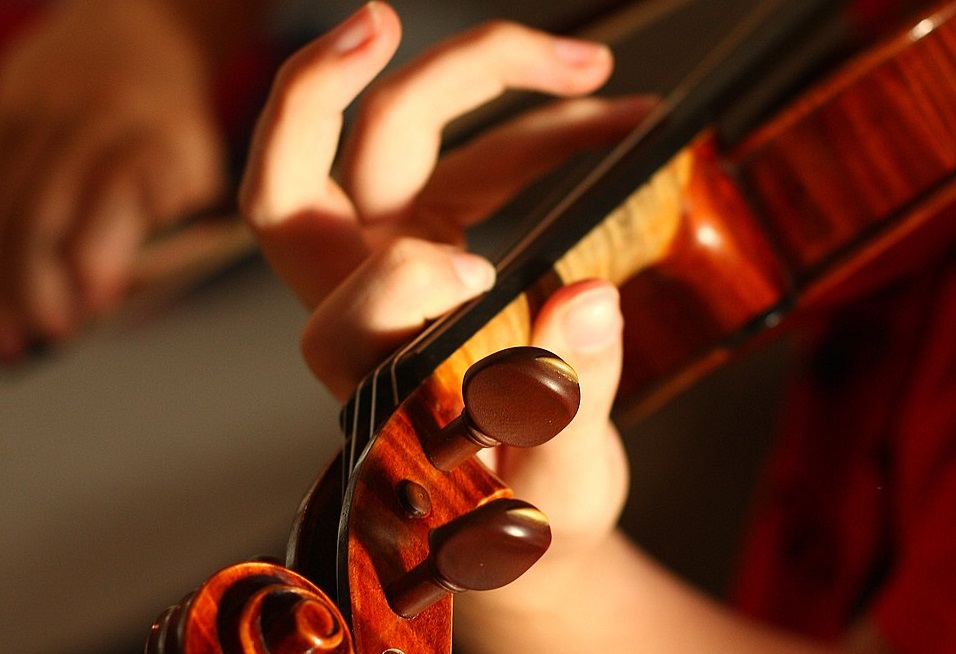 Photo: Alex via Wikimedia Commons
Essentially, a player might never even recognize that their intonation needs correction if they aren't paying close attention. A good tutor would ensure the student has a reference point and demonstrates the contrast between the ideal pitch and what the student is producing.
Then there are the situations involving relative pitch at the intermediate and advanced levels. Here, your intonation can be "wrong" according to a tuner, but still sound correct in the context of the notes you are playing.
As you can see, achieving good intonation is not a simple goal and is never a one-and-done deal. It is closely tied to muscle memory, which is why a failure to practice regularly can affect your intonation within days. Scales are a good remedy, but:
How do you Practice Scales Properly?
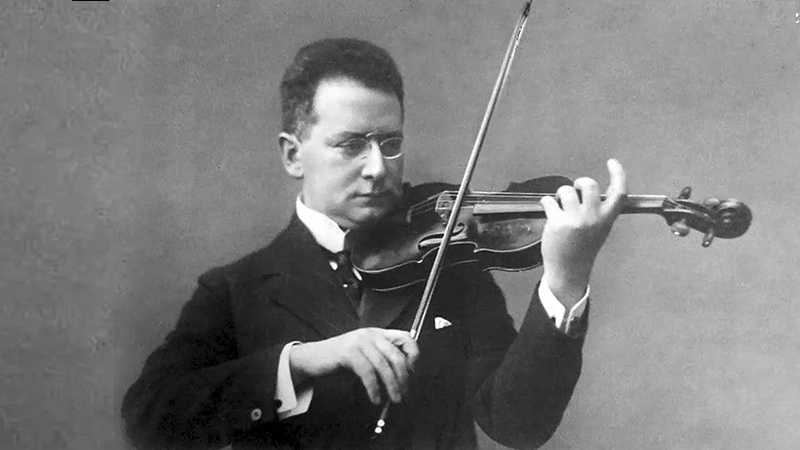
First, find a suitable scale routine like Carl Flesch (Note the gentleman with the John Lennon glasses above) or something by Ivan Galamian. Regardless of what scale routine you use, it should involve:
- Having an acceptable base intonation accuracy
- Metronome work
- Progressive notes slurs
- Rhythm combinations
- Verifying intonation through interval checks (double stopping the A notes on E string against your open A for an Octave interval, etc)
- Playing scales against a Cello drone from against the root note of the scale (G note for a G Major Scale)
- Verifying same note intonation on different strings at different positions
- Ensuring your shifts never mess up intonation around the shifted notes
- Arpeggios
- Dedicated interval practice
Of course, if you've never done more than standalone scales, these can be overwhelming. However, as long as you tackle these piecemeal, it should be relatively easy to approach.
There are a few more factors to focus on but they are best worked on in collaboration with a tutor. Even to this day, I find myself discovering a finger actually needs to be a millimeter higher than what I got used to.